

From Production Worker to Machinist: How to Move Into a Skilled Role
Machinist jobs are some of the hardest to fill, and most machinists learn on the job. Here is how to go from running a line to running the machine.
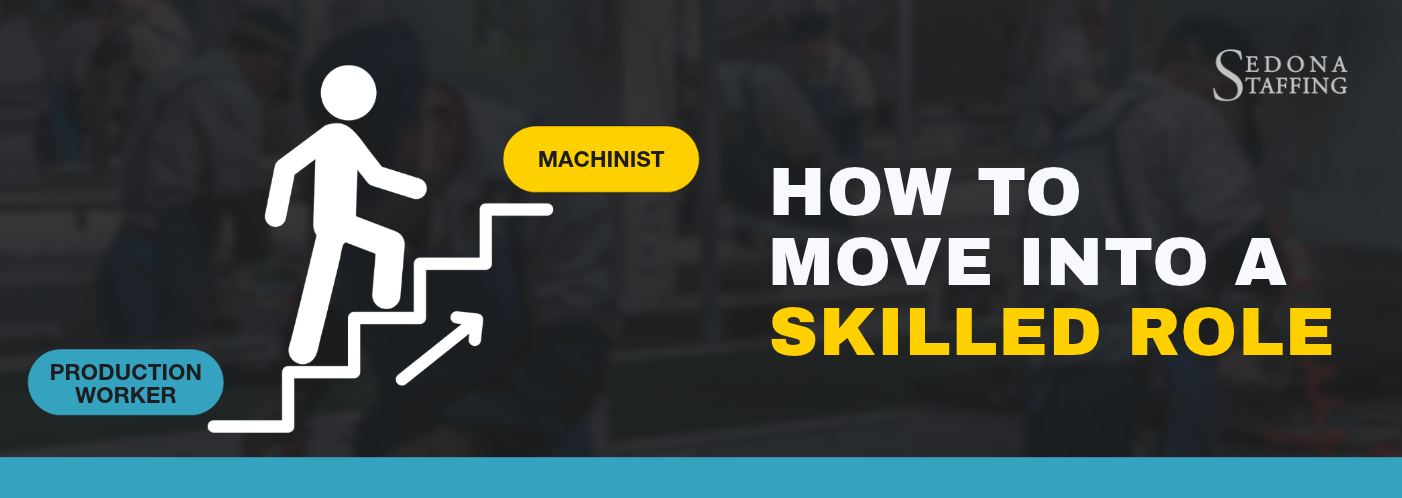
Yes, you can move from production work into a machinist job, and most machinists learn on the job. Build your measuring, blueprint, and math skills, ask for machine operator work, and look into apprenticeships. Openings stay steady as experienced machinists retire, so shops need people who can grow into the role.
Key takeaways:
- About 30,400 openings for machinists and tool and die makers are projected each year through 2035, all from replacing workers who retire or move on (BLS).
- Machinists typically need a high school diploma and are trained on the job (BLS).
- Reliability, measuring, and reading prints are the first skills to show.
- Machine operator and temp-to-hire jobs can be your way in.
Can a production worker really become a machinist?
Yes. Our recruiters at Sedona's Moline headquarters say the hardest roles to fill right now are the ones that need CNC machining skills. Shops need people, and many would rather grow one than wait for a perfect resume.
That fits how the trade works. Machinists typically need a high school diploma and are trained on the job, and trainees often begin as machine operators and gradually take on harder assignments (BLS). If you already run equipment, follow work orders, or check parts on a line, you're closer than you think.
What does a machinist do, and what does it pay?
Machinists set up and run manual and CNC (computer numerically controlled) machines like lathes, mills, and grinders to make precision metal parts. They read blueprints, adjust cutting tools, and check finished parts against the specs.
The pay step can be real. The median annual wage for machinists was $58,750 in May 2025, compared with $50,980 for all workers (BLS). Even with overall employment projected to dip slightly, BLS expects about 30,400 openings a year as experienced workers retire or move on.
What skills should you build first?
You don't need to program a CNC machine on day one. You do need to show you can learn. Focus on:
- Reliability. Show up on time, every shift. It's the first thing a shop trusts you with.
- Measuring. Get comfortable with calipers and micrometers. Ask a lead how your line checks parts.
- Prints and math. Learn to read a basic blueprint and work with fractions, decimals, and tolerances. BLS lists math and blueprint reading as useful coursework.
- Safety habits. Safety glasses, hearing protection, and a clean work area show you can be trusted around expensive machines.
How do you get your first machinist job without experience?
Start where you are. Tell your supervisor you want to learn, and ask to cross-train on a machine, help with setups, or shadow an operator.
Next, look at formal training. Apprenticeships are often sponsored by employers and pair paid on-the-job training with classroom instruction (BLS). You can search programs near you on the U.S. Department of Labor's Apprenticeship Finder. Community colleges and technical schools offer shorter certificate programs, too.
Then update your resume: the machines you've run, the parts you've measured, and any training you've finished.
How can a staffing agency help you make the move?
A recruiter can see openings you can't. Sedona Staffing often has access to job openings that aren't posted publicly, and our services are completely free for job seekers because our fee is covered by the companies that hire. We look beyond the resume, and we offer resume review and interview coaching (Job Seekers).
Most of our positions are temp-to-hire, so you can prove yourself on the floor before the company hires you on (Job Seeker FAQs).
For 40 years, Sedona Staffing has connected people with industrial, office, and technical work. If you're ready for the next step, search our current jobs or apply today, and tell your recruiter you want to move toward machining.
Questions We Hear:
Q. How do I become a CNC machinist without experience?
A. Start in a machine operator or production role, learn to measure and read prints, and ask to cross-train. Apprenticeships and community college certificates can speed it up.
Q. Do I need a degree to become a machinist?
A. No. Machinists typically need a high school diploma or equivalent and are trained on the job (BLS).
Q. How long does it take to become a machinist?
A. It varies. BLS describes long-term on-the-job training, and apprenticeships can last several years. Many people earn as operators while they learn.
This article is for informational purposes only and job placement or employment is not guaranteed. This article was written by our team of staffing experts. We leverage advanced AI tools to assist with research and composition, and every piece is reviewed and edited by our team.
Sources:
- U.S. Bureau of Labor Statistics, Occupational Outlook Handbook: Machinists and Tool and Die Makers (2025 pay; 2025–35 projections)
- U.S. Department of Labor, Apprenticeship.gov: Apprenticeship Finder
- Sedona Staffing, Job Seekers
- Sedona Staffing, Job Seeker FAQs
- Sedona Staffing, Job Search
- Sedona Staffing, About (established 1986)